

From Abracadabra to Zombies | View All
spontaneous human combustion (SHC)

Spontaneous human combustion (SHC) is the alleged process of a human body catching fire as a result of heat generated by internal chemical or nuclear action. While no one has ever witnessed SHC, several deaths involving fire have been attributed to SHC by investigators and storytellers. Charles Dickens used SHC as the cause of death of a heavy drinker in his novel Bleak House (1852), fueling a popular belief that excessive drinking could lead to SHC. Responding to criticism that he was encouraging nonsense, in the second edition of Bleak House Dickens claims he knew of some thirty cases of SHC, but he mentions only two.* Both cases allegedly happened over one hundred years earlier. Dickens or his source probably got his information about SHC from stories collected by Jonas Dupont published in De Incendiis Corporis Humani Spontaneis (1763).*
One 17th century tale claims that a drunken German self-ignited due to his having imbibed an excessive amount of brandy. If drinking a great quantity of brandy or any other alcoholic beverage causes self-combustion, there should be many more such cases to study.
Many of the modern SHC stories have originated with police and fire investigators who have been perplexed by partially burned corpses near unburned rugs or furniture. They are completely baffled as to how a body could burn down to ashes except for a leg or a foot, while the rest of the room avoids being consumed by the flames.
Many of the allegedly spontaneously combusted corpses are of elderly people who may have ignited themselves accidentally. Some may have been murdered. Many are elderly women who may have had osteoporosis, making their bones burn at a lower temperature than needed for healthy bones.* Self-ignition due to dropping a lit cigarette or ignition due to another person are ruled out by some investigators as unlikely because they think the whole room should have gone up in flames in such cases. Even when candles or fireplaces present a plausible explanation for the cause of a fire, some investigators favor an explanation that requires belief in an event whose likelihood is extremely implausible.
physical possibility of SHC
The physical possibilities of spontaneous human combustion are remote. Not only is the body mostly water, but aside from fat tissue and methane gas, there isn't much that burns readily in a human body. To cremate a human body requires a temperature of 1600 degrees Fahrenheit for about two hours. To get a chemical reaction in a human body that would lead to ignition would require some doing. If the deceased had recently eaten an enormous amount of hay that was infested with bacteria, enough heat might be generated to ignite the hay, but not much besides the gut and intestines would probably burn. Or, if the deceased had been eating the newspaper and drunk some oil, and was left to rot for a couple of weeks in a well-heated room, his gut might ignite. And in each of these ludicrous scenarios additional oxygen would have to be introduced. These possibilities are so farfetched that I have no reason to believe they, or anything like them, has ever occurred.
Larry Arnold's theory that sometimes human cells are hit by a mysterious particle, the pyrotron, that causes a nuclear chain reaction inside a person's body is based on wild speculation and ignorance of cellular life and spontaneous nuclear fusion.* Some other theories without merit are:
maser (microwave amplification by stimulated emission of radiation) induction, geomagnetism, and even kundalini (a form of yoga/mystic body heating). Perhaps the most preposterous suggestion is that stress can cause a person to burst into flames (perpetuated by Larry Arnold), or that hydrogen and oxygen remain as gasses in human cells and are thus highly ignitable – in which case the reader would do well not to inhale.*
A more economical and reasonable theory of how human bodies burn in rooms without having the entire room engulfed in flames is the idea of the wick effect. The ignition point of human fat is low and to get the fire going would require an external source. Once ignited, however, a "wick effect" from the body's fat would burn hot enough in certain places to destroy even bones. To prove that a human being might burn like a candle, Dr. John de Haan of the California Criminalistic Institute wrapped a dead pig in a blanket, poured a small amount of gasoline on the blanket, and ignited it. Even the bones were destroyed after five hours of continuous burning. The fat content of a pig is very similar to the fat content of a human being. The damage to the pig, according to Dr. De Haan "is exactly the same as that from supposed spontaneous human combustion." A National Geographic special on SHC showed a failed attempt to duplicate the burning pig experiment. However, it is obvious that the failure was due to leaving the door to the room open to the outside, which created a draft and led to the flames igniting everything in the room. Had the room been closed up, as are the rooms in which many of the elderly persons have died in fires attributed to SHC, it is likely that the pig would have smoldered for several hours without the rest of the room becoming engulfed in flames.
In their investigation of a number of SHC cases, Dr. Joe Nickell and Dr. John Fisher found that when the destruction of the body was minimal, the only significant fuel source was the individual's clothes, but where the destruction was considerable, additional fuel sources increased the combustion. Materials under the body help retain melted fat that flows from the body and serves to keep it burning. The reason some bodies are totally consumed except for the legs or feet probably has to do with the fact that these victims were seated when they caught fire and flames move upward. An alternative explanation is given by Brian J. Ford, who argues that bodies combust because of a high concentration of acetone and legs often have too little fat for acetone to accumulate. Ford writes:
....there is one flammable constituent of the body that can greatly increase in concentration. Triacylglycerol lipids cleave to form fatty acid chains and glycerol. The fatty acids can be used as an alternative source of energy through beta-oxidation, giving rise to the key metabolic molecule acetyl-CoA. This helps drive the energy-producing Krebs cycle within the mitochondria of cells.
If the body's cells are starved (which can occur during chronic illness and even during a workout at the gym), acetyl-CoA in the liver is converted into acetoacetate, which can decarboxylate into acetone. And acetone is highly flammable. A range of conditions can produce ketosis, in which acetone is formed, including alcoholism, high-fat low-carbohydrate dieting, diabetes and even teething.
Ford ignited scale models of humans made of pork tissue marinaded in acetone and fully clothed. The models "burned to ash within half an hour. The remains - a pile of smoking cinders with protruding limbs - were exactly like the photographs of human victims."
Some alleged cases of SHC are cases of spontaneous combustion but they are explicable by natural means. For example, a chemical reaction on or in a person's clothing can result in spontaneous combustion. The National Geographic special, mentioned above, investigated a case of a woman whose clothes suddenly caught fire and burned the skin on her thigh. The most likely explanation is that she put a shell in her pocket that was covered in sodium from a fireworks show that had taken place on the beach where she had retrieved the shell. Later, she stuck a wet handkerchief in her pocket with the shell. The sodium may have reacted with the water, releasing hydrogen that self-ignited,* causing her burns. In any case, she did not burn from the inside, as is claimed happens to SHC victims.
Richard Milton, the alternative scientist, lists several cases that he thinks are convincing proof of SHC. All but one of the cases he cites come from Larry Arnold, the one who posits an unknown particle that occasionally strikes a cell inside a person, causing a nuclear reaction. Here's a sampling.
-
Jean Lucille Saffin. This 61-year-old mentally handicapped woman burst into flames in her kitchen. "Her father, who was seated at a nearby table, said he saw a flash of light out of the corner of his eye and turned ... to find that she was enveloped in flames, mainly around her face and hands." The fire was put out with water by Mr. Saffin and his son-in-law. No cause of the fire was found. How does this qualify as a case of SHC? Because an unnamed policeman told Saffin's relatives that that's what he believed caused Jean's death. Milton is also impressed by the fact that the father and son-in-law claim the fire lasted only a minute or two (so there should be no surprise that the rest of the room didn't go up in flames!). Milton doesn't consider that the testimony of the father and son-in-law may be tainted.
-
Helen Conway. You've probably seen this picture before.
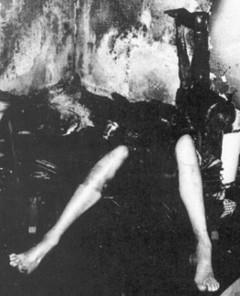
Conway was an elderly, infirm woman who was a heavy and careless smoker. (There were many cigarette burns in her room.) She burned up while sitting in an upholstered chair in her bedroom. Why is this considered SHC? The fire chief said that's what he believed. He also said it only took 21 minutes for her to burn. If it did, the wick effect would not account for how she burned. (Arnold uses some sort of "deduction" to figure out that it may have taken only six minutes for Conway's body to be consumed.) Since they can't figure out how Conway burned up in such a short time, both Arnold and Milton conclude it was probably SHC.
Joe Nickell speculates that the fire "may have begun at the base of the seated body and burned straight upward, fed by the fat in the torso, and may have thus been a much more intense fire - not unlike grease fires that all who cook are familiar with. Indeed, in searching through the dense smoke for the victim, an assistant chief sank his hand "into something greasy" that proved to be the woman's remains."*
Milton's research in this area is limited almost exclusively to Larry Arnold's book Ablaze!: The Mysterious Fires of Spontaneous Human Combustion, a book which features a blurb from Maury Povich on its back cover. Paranormal investigator Joe Nickell refers to this work as Spontaneous Human Nonsense.
The stories that Milton posts on his web site reveal his willingness to be dazzled by speculations about SHC. It is true that the examples he has chosen can't be explained by the wick effect because they are all of cases where the person in flames is come upon within a relatively short time of being on fire. The wick effect requires hours of slow burning. However, the evidence that any of these cases is actually a case of spontaneous human combustion is flimsy at best.
further reading
books and articles
Edwards, Frank. Stranger than Science (New York: L. Stuart,1959).
websites
Scorched earth policy of 'static man'
Spontaneous Human Combustion. Thoughts of a Forensic Biologist by Mark Benecke, Skeptical Inquirer 22(2) (1998), p. 47-51
New Light on Human Torch Story - human fat as a wick tested
"Spontaneous Human Combustion: No Longer a Burning Issue" by Al Seckel
"Not-So-Spontaneous Human Combustion" by Joe Nickell
FBI Debunks Spontaneous Human Combustion/ Despite Investigation, Believers Still Cite the Supernatural by Todd Venezia
Spontaneous Human Combustion - BBC.com Edited Guide Entry
Experiments in the combustibility of the human body by Angie M. Christensen
 Does spontaneous human combustion exist? --
Spontaneous combustion killed Irish pensioner, inquest rules
Coroner gives first spontaneous combustion verdict in 25-year career after man found dead in unexplained circumstances
... The West Galway coroner, Kieran McLoughlin, said there was no other adequate explanation for the death of 76-year-old Michael Faherty, also known as Micheal O Fatharta. He said it was the first time in his 25 years as a coroner that he had returned such a verdict....Garda Gerard O'Callaghan said he went to the house after the fire had been extinguished and found Faherty lying on his back in a sitting room, with his head closest to the fireplace. The rest of the house had sustained only smoke damage. O'Callaghan told the coroner that the only damage was to Faherty's remains, the floor underneath him, and the ceiling above....[Faherty's] body had been extensively burned and, because of the extensive damage to the organs, it was not possible to determine the cause of death....The state pathologist, Prof. Grace Callagy, noted in her post-mortem findings that Faherty had Type 2 diabetes and hypertension, but concluded he had not died from heart failure. (Bob Carroll comments: A 76-year-old man burns to death in front of his fireplace. The body's so badly burned that the cause of death can't be determined, yet one expert ruled out heart failure. What if the expert was wrong? What if poor Faherty ignited himself while tending to his fire and the excitement of trying to extinguish his blazing clothes caused him to fall and pass out? What kind of story is that? Not much, compared to hypothesizing spontanous human combustion.
As another expert notes in this story from the BBC:
Retired professor of pathology Mike Green said he had examined one suspected case in his career.
He said he would not use the term spontaneous combustion, as there had to be some source of ignition, possibly a lit match or cigarette.
"There is a source of ignition somewhere, but because the body is so badly destroyed the source can't be found," he said.

 spiritualism