

From Abracadabra to Zombies | View All
Reiner Rudolph Robert Protsch (von Zieten)
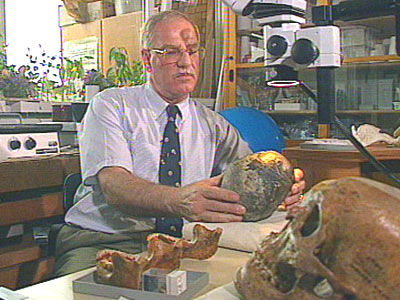
Professor Reiner Protsch von Zieten (b. 1939) was a professor of anthropology at Frankfurt University for 30 years before he was forced to resign in disgrace. A university committee revealed that throughout his career Protsch had plagiarized the work of colleagues and had systematically falsified dates on numerous "stone age" fossils, including a skull fragment - dubbed Hahnhöfersand Man - that allegedly linked humans and Neanderthals.
Protsch (the von Zieten honorific title appears to be bogus (Harding 2005)) dated the skull fragment at 36,000 years. He claimed it was found in a peat bog and was a vital missing link between modern humans and Neanderthals. The fragment is actually about 7,500 years old, according to Oxford University's radiocarbon dating unit. (Harding) Several fossils had been sent to Oxford in 2001 for testing of dates and it was then that the "dating disaster" was discovered. Protsch identified a female skeleton as a Neanderthal who died near the south-west German town of Speyer about 19,300 B.C. (the "Bischof-Speyer" skeleton). The lady actually lived around 1,300 B.C. Protsch also dated a skull discovered near Paderborn in 1976 at 27,400 years old and was considered the oldest human remain ever found in the region. The skull is now believed to date from the mid-18th century.
"The new data from Oxford is all wrong," Protsch told Der Spiegel (August 18, 2004). The Oxford scientists didn't remove shellac preservative from the specimens, he said. That's why the fossils dated as much younger. "Unfortunately, archaeologists and most anthropologists do not study physics or chemistry and therefore they cannot make judgments on carbon dating," he said. "Wrong measurements are made in all laboratories" (Paterson 2004). Apparently, Protsch didn't get the irony in his claim.
Frankfurt University's investigation of Protsch, who was suspended from the university in April 2004* and later forced to retire, was led by Professor Ulrich Brandt. During their investigation, the university discovered that Protsch was unable to work his own carbon-dating machine (Harding).
Thomas Terberger, the archaeologist who discovered Protsch's frauds, said that "Anthropology is going to have to completely revise its picture of modern man between 40,000 and 10,000 years ago. Professor Protsch's work appeared to prove that anatomically modern humans and Neanderthals had co-existed, and perhaps even had children together. This now appears to be rubbish."
On the other hand, Professor Chris Stringer of the Department of Palaeontology at London's Natural History Museum, says that Hahnhöfersand Man
was never regarded as a Neanderthal and was briefly important in the 1980s to people like Gunter Brauer, who were arguing for gene flow between Neanderthals and modern humans. However, as anyone who is familiar with the palaeoanthropological literature over the last 20 years would know, the find has been of negligible significance to recent debate. It has to be said that this is also a reflection of Dr. Protsch's low reputation in the field, as anyone familiar with the recent literature would also know (personal correspondence).*
Protsch seems to have returned to Germany after getting a doctorate from UCLA and then proceeded to spend much of his career faking discoveries and stealing from the work of others. His doctoral dissertation was titled "The dating of Upper-Pleistocene Subsaharan fossil hominids and their place in human evolution: with morphological and archaeological implications." The degree was awarded in 1973, the same year that the same UCLA department of anthropology awarded a doctorate to Carlos Castaneda.
According to the Guardian,
In one case he had claimed that a 50 million-year-old "half-ape" called Adapis had been found in Switzerland, an archaeological sensation. In reality, the ape had been dug up in France, where several other examples had already been found.
In addition to being forced to retire, Protsch is under police investigation for allegedly trying to sell 278 chimpanzee skulls that belonged to the university to a U.S. dealer. Protsch claims that he got the skulls from a Heidelberg ethnologist in 1975 and denies any wrongdoing (Paterson).
It was also reported by Der Spiegel that Protsch, the son of a Nazi MP, is under investigation by Frankfurt University for ordering the shredding of documents housed in the anthropology department relating to gruesome scientific experiments done by the Nazis in the 1930s.
One might wonder how he got away with his deceptions for so long, but the important thing is that his fraud was discovered by scientists, reported by scientists, and it will be scientists who will work to correct the record. This is how science works. Sometimes the discovery is quick as in the case of Archaeoraptor. Sometimes it is slow as in the case of Piltdown. But eventually the correction occurs.
Frankfurt University's president, Rudolf Steinberg, apologized to "all those harmed by" Protsch and acknowledged that the institution's administration had ignored the professor's misconduct for decades despite existing proof for his mistakes. "A lot of people looked the other way," he said. In the future, he said, students and new employees will be instructed in what constitutes appropriate scientific research behavior.
One would hope that the anthropological community would learn from this episode as well. No single scientist, regardless of his or her status, should be taken at his or her word about the dating of a fossil that has significant implications for the discipline. That lesson should have been learned from the Piltdown hoax. It will not be surprising if it is discovered that German nationalism played a role in Protsch's success, as English nationalism did in Piltdown's.
__________
*note In an article dated August 22, 2004, Tony Paterson in the Telegraph quoted Professor Stringer as saying "What was considered a major piece of evidence showing that the Neanderthals once lived in northern Europe has fallen by the wayside. We are having to rewrite prehistory." Stringer denies having made the statement: "I remember talking to the reporter concerned, and from what I remember the words in question were what he said to me, with him asking whether I agreed with the statement." Stringer also says the Paterson quote "is a made-up quote, as I never placed great weight on the significance of the Hahnofersand find in the first place. It was never called a Neanderthal as far as I know, but certain people saw "mixed" features in its morphology. Its removal is certainly not rewriting anything I have ever said about the Neanderthals, let alone rewriting prehistory!" (personal correspondence)
See also Piltdown hoax, Carlos Castaneda and Frauds and Hoaxes.
further reading
news stories

 Protocols of the Elders of Zion