
From Abracadabra to Zombies | View All
crystal skull
"I personally feel that the Crystal Skulls are not only here to share ancient knowledge and wisdom, but to assist in awakening our race to higher spiritual laws and understanding of itself....If the Crystal Skulls were not brought by extraterrestrials then certainly we must conclude their [sic] have been civilizations much more technologically or spiritually advanced than our own today." --Joshua "Illinois" Shapiro"[The] crystal stimulates an unknown part of the brain, opening a psychic door to the absolute." -- Frank Dorland
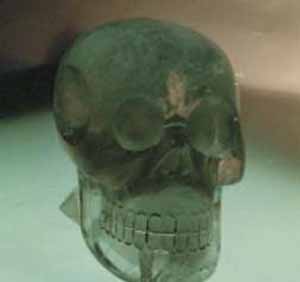
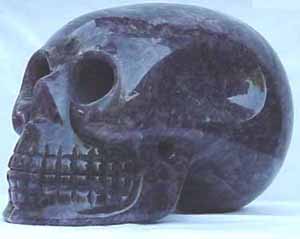
A crystal skull is a stone carving in the shape of a human skull. The sculptures vary in
size from a few inches to life-size. Some are made of pure quartz crystal, but many are
made of other types of stone found in abundance on Earth. Some stone skulls
are genuine artifacts from Mesoamerican cultures such as the Aztecs and are known as skull
masks or death heads. But the crystal skulls that interest
New Agers are
extraterrestrial in origin or come from Atlantis.
They allegedly are endowed with magical powers such as the spontaneous production of holographic images and
the emission of weird sounds.
Today, millions of skulls, made of various types of
stones and metals, are manufactured in a variety of sizes for the New Age paratrinket market, as well as for the museum
replica market. And, despite the fact that replicas are easily made and are
available from a variety of
sources, advocates of the paranormal nature of crystal skulls like Nick
Nocerino claim that no one knows how
these skulls were made and that they are impossible to duplicate. Nocerino is the founder of the The
Society of Crystal Skulls, International. His society uses psychometry,
remote viewing, and scrying
as part of their research methodology.
human skull. The sculptures vary in
size from a few inches to life-size. Some are made of pure quartz crystal, but many are
made of other types of stone found in abundance on Earth. Some stone skulls
are genuine artifacts from Mesoamerican cultures such as the Aztecs and are known as skull
masks or death heads. But the crystal skulls that interest
New Agers are
extraterrestrial in origin or come from Atlantis.
They allegedly are endowed with magical powers such as the spontaneous production of holographic images and
the emission of weird sounds.
Today, millions of skulls, made of various types of
stones and metals, are manufactured in a variety of sizes for the New Age paratrinket market, as well as for the museum
replica market. And, despite the fact that replicas are easily made and are
available from a variety of
sources, advocates of the paranormal nature of crystal skulls like Nick
Nocerino claim that no one knows how
these skulls were made and that they are impossible to duplicate. Nocerino is the founder of the The
Society of Crystal Skulls, International. His society uses psychometry,
remote viewing, and scrying
as part of their research methodology.
The myth of crystal skulls as extraterrestrial and extra-powerful seems to have begun with F. A. "Mike" Mitchell-Hedges (1882-1959) and his adopted daughter Anna. Their creative fictions have been uncritically promoted by Frank Dorland, author of Crystal Healing: The Next Step, and Richard Garvin, author of The Crystal Skull: the Story of the Mystery, Myth and Magic of the Mitchell-Hedges Crystal Skull Discovered in a Lost Mayan City During a Search for Atlantis (1973). The myth has been carried on by Ellie Crystal, who likens the quest for crystal skulls to the quest for the Holy Grail, and Josh Shapiro, co-author (with Nocerino and Sandra Bowen) of Mysteries of the Crystal Skulls Revealed.
the skull of doom
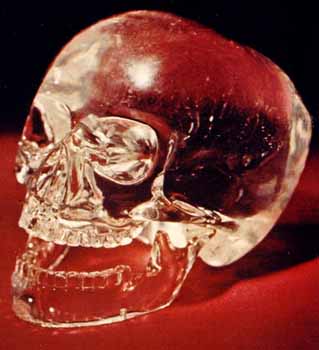
The most famous crystal skull is the Mitchell-Hedges "skull of doom," allegedly discovered by a 17-year old Anna Mitchell-Hedges in 1924 or 1927 while accompanying her adoptive father on an excavation of the ancient Mayan city of Lubaantun in Belize, where the elder Mitchell-Hedges believed he would find the ruins of Atlantis. The evidence collected by Joe Nickell proves beyond a reasonable doubt that Mitchell-Hedges bought the skull at a Sotheby's sale in 1943 for £400.
This clear quartz skull is about 5.25 inches high and weighs about 11 pounds. It superficially resembles stone skulls made by the Aztecs. The Aztec skulls are stylized, however. The Mitchell-Hedges skull is realistic with a detachable jaw.
Much of the occult and sinister legend surrounding the so-called skull of doom originated with Mitchell-Hedges, who claimed that the
Skull of Doom is made of pure rock crystal and according to scientists it must have taken over 150 years, generation after generation working all the days of their lives, patiently rubbing down with sand an immense block of rock crystal until finally the perfect Skull emerged.
It is at least 3,600 years old and according to legend was used by the High Priest of the Maya when performing esoteric rites. It is said that when he willed death with the help of the skull, death invariably followed. It has been described as the embodiment of all evil (F.A. Mitchell-Hedges).
The age of the object, as well as the other claims made about its making and history, were fabricated by Mitchell-Hughes. The man who owned the piece, Sidney Burney, and those who were on the Lubannatun expedition, denied that Mitchell-Hedges found the skull. Mitchell-Hedges himself never mentioned the skull until just after he bought it in 1943.
Anna has continued the hoax. Even though there is no evidence that she was even at Lubaantun when the discovery was supposedly made, she has maintained that Burney only had the piece on loan from her father until he could pay off a debt he owed Burney. If so, why didn't her father just pay Burney back instead of bidding for the item in an auction? Here is the story told on the "Official Website" of F. A. and Anna Mitchell-Hedges:
In 1943, Mitchell-Hedges got embroiled in another controversy that still rages in some quarters to this day. In times before burglar alarms, it was not unusual to leave valuable items with friends if one was going away for long periods of time.
Mitchell-Hedges did this with a school friend, Sidney Burney, who had always shown an interest in the Crystal Skull. However, in 1943, Burney inexplicably put the Crystal Skull up for auction at Sotheby’s in London.
Mitchell-Hedges learnt of this the day before and was so furious that for a while he was unable to speak. Unable to contact Burney, he arose the next day at 5am and traveled to London to retrieve his property.
Sotheby’s informed him that the vendor was Sidney Burney’s son. When they refused to withdraw it from the sale, Mitchell-Hedges realized the easiest way of regaining his property was to purchase it back. This he did for £400.*
In any case, Anna has received some attention and made a few dollars over the years by putting her skull on display, claiming it came from outer space and was kept in Atlantis before it was brought to Belize.* She is still in possession of the skull, but seems to have tired of the publicity and has retired it from public viewing.
In 1970, Anna let Frank Dorland, a crystal carver, examine her skull. Dorland declared that it is excellent for scrying and it emits sounds and light, depending on the position of the planets. He claimed that the skull originated in Atlantis and was carried around by the Knights Templar during the crusades. He claims they had the skull examined at a Hewlett-Packard lab. D. Trull uncritically reports that the lab found that the skull
had been carved against the natural axis of the crystal. Modern crystal sculptors always take into account the axis, or orientation of the crystal's molecular symmetry, because if they carve "against the grain," the piece is bound to shatter -- even with the use of lasers and other high-tech cutting methods.
To compound the strangeness, HP could find no microscopic scratches on the crystal which would indicate it had been carved with metal instruments. Dorland's best hypothesis for the skull's construction is that it was roughly hewn out with diamonds, and then the detail work was meticulously done with a gentle solution of silicon sand and water. The exhausting job -- assuming it could possibly be done in this way -- would have required man-hours adding up to 300 years to complete.*
Dorland's claims formed the basis of Garvin's book on crystal skulls.
The questionable origin of the Mitchell-Hedges skull has not deterred belief in the skull's mysterious properties. Rather, at least 13 other skulls have mysteriously appeared over the years. Some of these skulls are claimed to have magical origins and healing powers. However, a study of several crystal skulls by the British Museum in 1996 indicates that the only magic involved in the creation of these skulls was in keeping their fraudulent origin a secret. The study concluded that the skulls were made in Germany within the past 150 years. The recent origin explains how they were made with tools unavailable to the ancient Mayans or Aztecs.
Using electron microscopes, the researchers found that two of the skulls possessed straight, perfectly-spaced surface markings, indicating the use of a modern polishing wheel. Genuine ancient objects would show haphazard tiny scratches from the hand-polishing process.*
A similar result occurred in 1992 when the Smithsonian received a crystal skull from an anonymous source who claimed it was an Aztec skull that had been bought in Mexico City in 1960. Research by the Smithsonian concluded that several crystal skulls popular with the New Agers originated with Eugene Boban, a Frenchman of dubious character. Boban dealt in antiques in Mexico City between 1860 and 1880, and seems to have acquired his skulls from a source in Germany. Jane MacLaren Walsh of the Smithsonian concluded that several crystal skulls held in museums were manufactured between 1867 and 1886 ("Crystal Skulls and Other Problems," Smithsonian Institute Press, Washington DC, 1996). In the May 27, 2010, online edition of Archaeology Walsh states that she "had two opportunities to examine the Mitchell-Hedges skull closely and to take silicone molds of carved and polished elements of it, which I have analyzed under high-power light and scanning-electron microscopes....The microscopic evidence presented here indicates that the skull is not a Maya artifact but was carved with high-speed, modern, diamond-coated lapidary tools....It is not unreasonable to conclude that the Mitchell-Hedges skull, which first appeared in 1933, was also created within a short time of its debut. "
more skullduggery?
Other so-called ancient crystal skulls have had histories as dubious as the Mitchell-Hedges skull. For example, a skull called "Max" was supposedly given to the people of Guatemala by a Tibetan healer. Another pair of skulls, known as the British Skull and the Paris Skull, was allegedly found in Mexico in the late 19th century by mercenaries. They are very similar and one may have been the model for the other. The Paris skull is said to represent Mictlantecuhtli, the Aztec god of the dead. It is not alleged to have any occult powers, however.
The Mayan Skull and the Amethyst Skull were allegedly found in Guatemala early in this century. "Nick" Nocerino claims he met a shaman in 1949 while traveling in Mexico who led him to a Mayan priest who said he was authorized to sell the skulls because the village needed money for food. Nick didn't buy them, but he studied them scientifically and found some startling things such as "its true origin is cloaked in mystery" and it had the power to give him hours of meaningful visions.
There isn't a shard of evidence that these crystal skulls are mysterious in any way. What is mysterious is their continued popularity and the continued mythology as to their origins and powers.
See also crystal power.
further reading
books and articles
Lewallen, Judy R. "The San Luis Valley crystal skull: A transparent mystery," Skeptical Inquirer, September/October 1997.
websites
The Skull of Doom by Jane MacLaren Walsh, Archaeology, May 27, 2010
Dan Akyroyd's Crystal Skull Vodka promotion (Words escape me. Just when you thought you'd heard of everything.)
Crystal Skulls: Skeletons of a Mysterious Past by D. Trull
The Mitchell-Hedges Skull: King of the Crystal Skulls by D. Trull
Origin Theories: Celestial Gifts or Skullduggery? by D. Trull
More Crystal Skulls: A Boneyard of Precious Stone by D. Trull
news stories
 Aztec'
Crystal Skull 'Likely to Be Fake'
Aztec'
Crystal Skull 'Likely to Be Fake'
Rare crystal skull comes to Carmel (not a hint of skepticism by the author!)
 crystal power